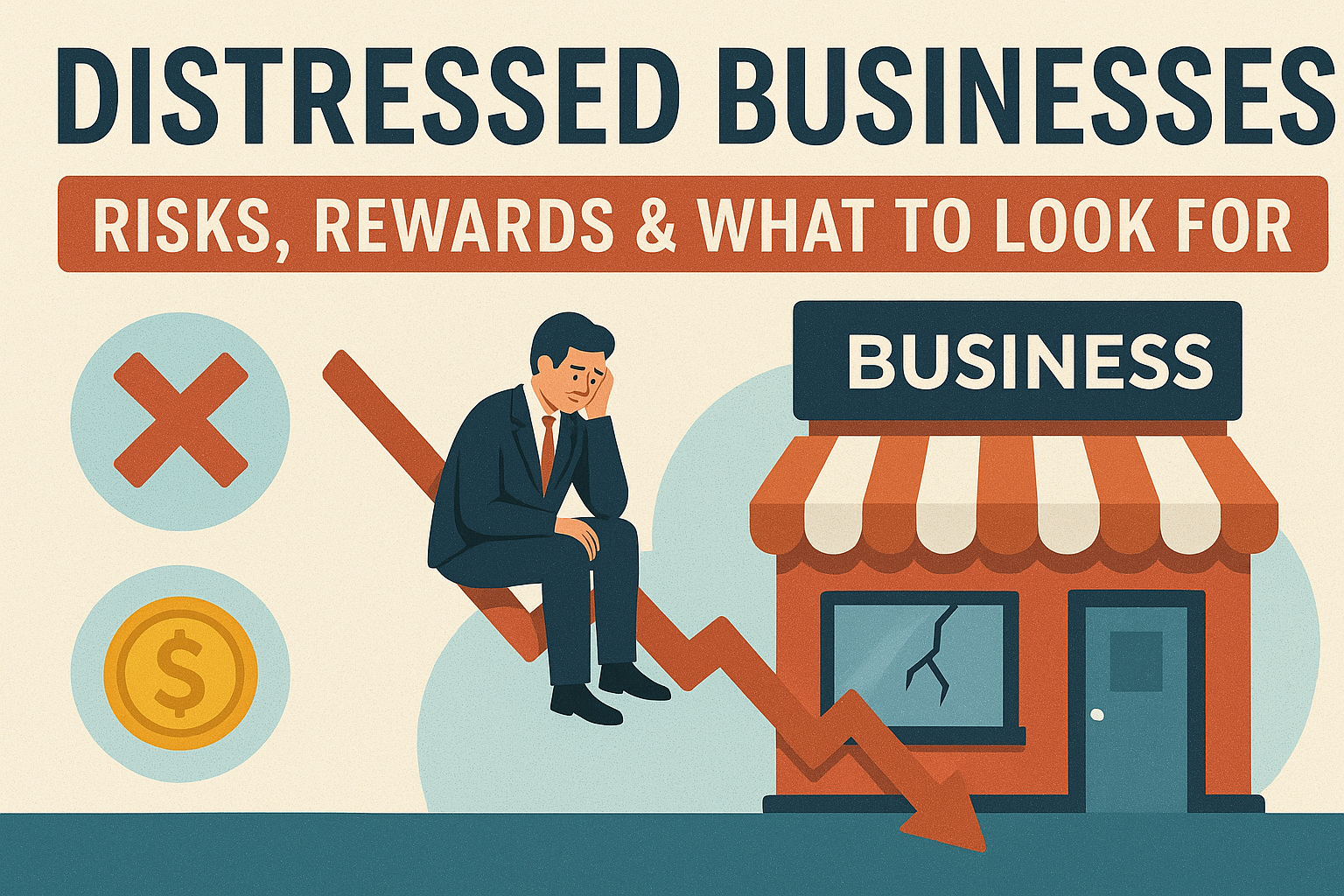
- Distressed businesses in the UK In this Episode… distressed businesses in the UK offer significant risks and rewards and what to look for. Don’t forget to subscribe to our YouTube Channel!
- Buying distressed businesses can bring low prices, expanded market share and opportunities to unlock hidden assets, but these need to be weighed against hidden liabilities and cash flow issues.
- We will need effective risk management, including detailed financial, legal and operational due diligence, to spot threats such as hidden debts, legal disputes and reputational damage.
- Structuring the deal correctly through asset purchase, share purchase, or pre-pack administration can lessen exposure and increase benefits.
- Strong leadership and staff morale are essential to successful turnarounds, recovery, and long-term profitability.
- Investors must not lose sight of thorough due diligence checklists and stay aware of changing market and economic conditions across the UK.
Distressed businesses are companies with cash flow problems, excessive debt or sluggish sales. They are companies on the brink of failure or acquisition. A lot of UK investors look at these firms for both risk and reward. Risks include dramatic declines in value, unemployment or abrupt changes in company strategy. Some see rewards in opportunities for rapid growth, low share prices or new opportunities for workers and consumers. Top signs to look out for are unpaid bills, downsizing employees and decreasing sales. Knowing these factors helps identify safe buying or selling windows. In the coming sections, find out what is key to consider in counterbalancing the upside and downside of UK distressed businesses.
The Distressed Business Landscape
What does a distressed UK business look like? A dearth of cash is a common theme, hindering investments or even the ability to pay bills. If debtor days, the amount of time it takes to get paid, or creditor days, the time taken to pay suppliers, begin to rise, that’s frequently a warning sign. These indicators hint at deeper financial problems. To identify a distressed business, it’s crucial to examine its accounts, including balance sheets, P&Ls and cash flow statements. They reveal whether a firm’s merely had a poor period or is wrestling with structural challenges. Often it is a distressed business that tempts buyers with the prospect of a bargain. A distressed sale discount, typically 20 to 40 per cent, usually applies. This lower price may seem appealing, but it has its risks.
Economics are a key factor in the distressed business landscape. In the UK, slow growth, higher interest rates and changes in consumer spending can affect companies badly. For instance, high street shops have suffered falling footfall as online shopping proliferates. Energy prices and supply chain problems put further strain, particularly on businesses with narrow margins. Retail, travel and hospitality are the most exposed to distress in difficult times. Yet some sectors can bounce back quicker than others. How do tech and health care often recover with the rest of the economy, while construction and retail may lag?
The prospects for revival depend upon why the business is distressed. If it’s due to temporary or one-off issues, such as a supply shock, the outlook might be a little better. If the problems are structural, such as obsolete products, bad management, or debt, then the recovery is much more difficult. Buyers must understand the backstory behind the figures before pulling the trigger. Establishing rapport with the business owner may assist both parties in doing a just deal. Occasionally, launching a brand-new company from the ground up is a better idea than attempting to address legacy issues.
| Sector | Recovery Potential | Key Challenges | Main Competitors |
|---|---|---|---|
| Retail | Low to Medium | High fixed costs, shift to online | Supermarkets, e-commerce giants |
| Hospitality | Medium | Staff shortages, changing demand | Major hotel chains, fast-food brands |
| Tech | High | Fast change, talent retention | Start-ups, global tech firms |
| Construction | Low to Medium | Supply issues, contracts | National builders, local firms |
| Healthcare | High | Regulation, funding | NHS, private health providers |
Uncovering the Potential Rewards
Investing in distressed companies can present opportunities to acquire assets at a bargain. A lot of UK firms have been hit hard post-pandemic, resulting in more asset sales and partnerships. Done the right way, purchasers can discover headroom, increase their market share and access value others could overlook. Rigorous checks and a firm understanding of the business’s finances are essential for effective decision making.
Low Entry Cost
Purchasing a distressed business is generally cheaper than acquiring a healthy one. Lower prices can mean better investment margins if the company is turned around. Third-party valuation independent helps to strike a fair price and catch any hidden risks. Having to put down less cash up front makes these deals accessible to both small and large investors.
- Lower upfront costs free up cash for alterations or enhancements.
- Easier access for buyers with limited funds.
- More flexibility to negotiate terms with creditors.
- An early opportunity for debt resolution and release of critical claims.
Cheap stocks can pay off with greater risk. Traditional risk checks may not be effective, requiring buyers to find new methods of identifying risks.
Market Share
Acquiring a failing competitor could be the secret for rapid business growth. You can buy a bigger chunk of the market for less than building from the ground up. This could mean more customers, new channels, or better reach in a region. Sometimes it means lower competition and a more powerful brand.
- Blend sales teams to reach more clients.
- Use joint warehousing and supply chains.
- Combine marketing for better brand awareness.
- Streamline services to keep key accounts.
Consolidation can create a stronger business only if the new firm is able to retain its customers and staff.
Untapped Assets
Distressed companies can have under-utilised assets such as property, shares, patents or tech. How much could be at stake in terms of intellectual property, including trademarks and data? Optimising these assets or offloading what’s unnecessary can increase returns.
Finding under-monetised digital tools, hardware or distribution rights can provide a boost. Some buyers do get opportunities to cash out by disposing of some things post-purchase.
Turnaround Profit
Turnaround profit The profit of rescuing a failing business. Realising a profit post-takeover requires smart planning and astute management.
- Review costs and cut waste.
- Reshape the team and set new goals.
- Change the product mix or pricing.
- Invest in marketing and customer service.
Great managers identify gaps and move quickly. Not all will be a massive turnaround. The time to profit will depend on the business. Many see one to two years for change, especially with clever moves and diligent checks.
Navigating the Inherent Risks
Distressed companies have their own levels of risk, lurking behind the potential for reward. Savvy investors understand the importance of a thoughtful, active style, influenced by value investing and attention to detail. Every risk, from concealed debts to market rejection, can tip the balance either way. Accurate financial data is scarce, so a comprehensive investigation and adaptable risk controls are essential. Lessons from previous crises, such as in 2008, show certain asset classes recover if managed appropriately, but nothing is assured.
1. Hidden Liabilities
Off-Balance Sheet liabilities are a real risk. These might be unpaid taxes, pending lawsuits or unpaid supplier debts. Even seasoned investors can be blindsided by such shocks.
Exploring the books, talking to previous managers, and probing third-party suppliers reveals what’s not immediately apparent. Legal checks and forensic audits are a big part too.
Hidden financial liabilities can gut value, overturn projections and render a potential transaction unviable. Defending against this is all about structuring deals with provisions that address unidentified debts, such as escrows or indemnities.
2. Cash Burn
Ripe for abuse, fast cash outflows can easily get out of hand. A cash-burning business can go broke before the turnaround finally arrives, no matter how strong its core.
Monitoring expenses, freezing discretionary projects and renegotiating payment terms can slow cash burn. Forecasting future requirements and preparing for uneven recovery trajectories are key.
Of course, some investors try staggered funding or milestone payments to mitigate risk. Without management, cash burn can prematurely terminate a turnaround.
3. Reputational Damage
A sullied reputation can stick and be difficult to reverse. Occasionally, suppliers or lenders remain cautious long after a company is rescued.
Transparent, candid updates restore trust. New leadership or ownership heralds change. Actions speak louder than words.
It can take years to undo reputational damage. Long-term thinking and a patient strategy are required to earn back goodwill.
4. Staff Morale
Layoffs, pay cuts, and uncertainty can sap morale fast. Your staff will leave for safer jobs and take crucial knowledge with them.
Keeping your teams informed and engaged certainly helps. Recognition and little victories can improve morale. Leadership shifts can disrupt individuals or if executed well, rejuvenate teams.
Keeping morale up is not a one-shot effort. It requires constant care and transparency.
5. Market Rejection
After a rescue, markets may not buy the new badge or pitch. Customers link the brand with historical woes and shun it.
Market research pre-relaunch helps identify what has to change. Refreshing products, pricing or branding can be a means of winning back trust.
A strong, precise proposition quite commonly regains any lost ground. Bad placement or even weak messaging can see it flounder once more.
The Due Diligence Checklist
A due diligence checklist gives buyers and investors a way to look beyond the surface of distressed businesses. It spans everything from financials to legal status and operations. An organised checklist is vital in reaching honest decisions, pricing fairly, and identifying red flags before they are too late. In the UK, this translates to contracts, employee agreements, leases and local regulations being checked. It can take weeks or months, depending on the size and complexity of the business. Risk heatmaps or RAG matrices allow for findings to be shared swiftly among teams.
Financial Scrutiny
Begin by reviewing all principal financial statements—balance sheet, income statement and cash flow statement. This paints a clear picture of a company’s health. Look for gaps, unaccounted-for amounts, and financial mismanagement (overdue debts, late supplier payments, etc.). Cash flow analysis is even more critical, particularly for distressed firms, where keeping the lights on counts more than bottom line profit.
Look into the history. Are sales consistent, plummeting or up-and-down like a rollercoaster? What about profit margins? Take note of unrealistic future revenue forecasts. It is better to use future projections as one of several pieces of evidence, not the only reason to buy in.
Terrible history with cash indicates a much higher risk. It may signal bad practices or more serious problems. Perhaps funds have been caught up in court cases or used to cover losses.
Legal Hurdles
Legal due diligence is verifying that there are no ongoing disputes, unpaid claims or pending cases. Pay close attention to existing contracts: customer deals, supplier agreements, staff contracts, and leases. Regulatory compliance is non-negotiable, not only industry regulations but also GDPR, health and safety, and local council permits.
Do they have a history of fines or breaches? Take this as your cue to be on alert. Problems here could drag out post-sale and impact future returns. Legal advice provides invaluable perspective and guides purchasers from pitfalls in contract wording or concealed indemnities.
Operational Audit
Watch how the company operates. Are there weak links in the chain? An operational audit looks for waste, slow processes or outdated systems. This can reveal quick wins for savings or long-term change. A retail shop, for example, could have manual stock checks that could be automated, saving time and money.
Understand the systems. Data and cybersecurity must be in order, particularly if the business operates online. Poor controls here could lead to risks that outlive the sale.
- Operational insights help to make things right. They can contribute to a risk matrix, indicating where effort or investment will have the largest impact.
Structuring the Right Deal
Getting the structure right is key to de-risking and shaping the return when buying a distressed business in the UK. Deal type, terms and documentation all influence liability, control and future value. Here’s a table showing common deal structures, including their main advantages and disadvantages.
| Deal Structure | Advantages | Disadvantages |
|---|---|---|
| Asset Purchase | Pick assets, leave most liabilities, tax flexibility | May need asset transfers, TUPE applies, complex |
| Share Purchase | Full control, keep licences/contracts, simpler transfer | All liabilities assumed, hard to carve out assets |
| Pre-Pack Administration | Quick, business continuity, debts left behind | Seen as less transparent, reputational risk |
Asset Purchase
Asset purchases allow buyers to select what they desire, from brands, inventory, equipment, to client lists. This can reduce risk, as you don’t have to take on unwanted debts or legacy problems the company may have. Buyers frequently resort to asset purchases for companies with significant litigation or tax liability.
You can go after assets that go with your punting – machinery, property, or even digital rights. Note that some assets, such as contracts or licences, require third-party consent to assign. Staff will transfer to you under TUPE by law, so take this into account in your costs and plans.
Responsibility is less than with a share deal, but not zero. Some risks, such as environmental clean-up or tax payable on assets, may survive. The Asset Purchase Agreement is vital to clarify what is included, a price, and restrictions.
To optimise asset purchases, conduct rigorous due diligence and include warranties against important risks, accepting that in distressed deals, such protection is sparse.
Share Purchase
Share deals mean you’re acquiring the whole company. You get all employees, contracts and clients, but you also get all debts and possible claims. This approach is most effective if your contracts or licences can’t easily be transferred.
You have absolute power and continuity, but you have all the dirty little secrets. Watch out for off-balance sheet liabilities, litigation or legacy contracts. Due diligence is important, but time is almost never on your side in a distress sale.
The Share Purchase Agreement lays out what’s being purchased, the price and who’s responsible for what. Even so, warranties and indemnities could be limited so price reflects the risks.
Pre-Pack Administration
Pre-pack is when a sale is negotiated ahead of administration commencing and then concluded as soon as the administrator is in place. This keeps the company afloat, preserves value and leaves legacy debts with the insolvent company.
Deals come in quickly, but pre-packs are viewed as opaque and worrying for employees, suppliers, and creditors. Regulators monitor these closely, so openness and adherence are instrumental.
Pre packs appeal to buyers who want a quick entry and are prepared to work with regulators and administrators. They provide a route to rescue jobs and preserve the business, with less room for haggling or due diligence.
The Human Element of Turnaround
Human Element of Turnaround
In the UK, most companies don’t get into difficulty from figures on a balance sheet but from the individuals behind them. Stress, low morale, or a couple of people holding all the knowledge can take a business to the brink. When leaders intervene to put things right, these human aspects require equal focus as cash flow.
The Human Dimension of Turnaround is a “what we learned” piece, isn’t it? Most UK companies are still run by owners and a few old-timers on a day-to-day basis. If these employees depart, or intelligence remains retained with only a small number, it all can unravel quickly. Owners are frequently called upon to make every decision, so the business is vulnerable. When revenues continue to decline quarter after quarter, it usually indicates deeper issues. Perhaps leadership is out of touch, or staff members have checked out. Staff can be reluctant to change if they fear job losses or new working practices. This resistance, typical of most turnarounds, can hinder or even close off recovery.
Evaluating strategies for effective leadership during turnaround means more than issuing new rules or targets. The first change in a solid turnaround plan often starts with top management. Leaders must be present, clear, and honest. They need to face hard truths with the team, show a clear plan, and be ready to make tough choices. Sometimes, this means letting some people go or moving them to other roles. These calls can be hard but may be needed to keep the business alive. Leaders who talk straight and check in often help staff feel less lost. Good leaders know to focus on five to seven key signs, like cash flow, sales, and team effort, that show if things are getting better.
Teamwork can be crucial. When our people come together, share tasks, and cover one another, it runs easier. If only a handful hold all the cards, or if trust is low, the business remains fragile. Teams that communicate, collaborate, and support each other can identify risks earlier and discover solutions more quickly.
Fostering a culture of resilience and adaptability keeps the business agile. When people feel safe to share and experiment, they deal with disappointments more effectively. Businesses in which everyone is aware of the plan and can monitor progress, however slowly, recover much quicker.
Conclusion
Purchasing or backing a distressed business has real highs and lows. Some view it as a bargain buy, praying for a jackpot. Others see hard graft coming with no guaranteed remedy. Genuine victories contain raw truths – numbers, people and what the location actually desires. The risks are not small or hidden. They appear in cash, personnel and time. Some buyers hit a great turn, while others confront painful loss. In the UK, rules and custom dictate how deals unfold. To find a deal that suits, ask blunt questions, keep a close eye, and trust your instincts. Know what you want before you jump. For more stories, advice or to share your own, chat with us today.
Frequently Asked Questions
What is a distressed business?
A distressed business is a company that is struggling with severe financial or operational issues. Such problems could be poor cash flow, increasing debts or falling sales in the UK.
What are the main risks in buying a distressed business?
Purchasing a distressed business comes with risks like unknown liabilities, litigation, and unpredictable financial performance. Due diligence is critical to avoid expensive surprises.
What rewards can investors find in distressed businesses?
Investors buy assets cheaply, rapidly gain market share and turn a business round for profit. The UK market frequently presents unique investment opportunities in the retail and hospitality sectors.
What should be included in due diligence for distressed businesses?
UK purchasers will need to review financials, warranties, employment contracts and third-party agreements. Finding all debts and liabilities is crucial before any purchase.
How can you structure a deal for a distressed business?
Structure deals on clear terms, staged payments and protection from old debts. UK lawyers experienced in distressed assets can protect your interests.
Why is the human element important in business turnarounds?
Staff morale and skill count. Dealing with the current team in the UK can preserve their expertise and facilitate a more rapid recovery.
Are there specific sectors in the UK where distressed sales are more common?
Absolutely, retail, hospitality and construction typically have more distressed sales in the UK, particularly in times of economic downturn or shifts in consumer behaviour.